A school corridor and a bank counter both need film. They need different film, different anchoring and different paperwork. These are the ten building types our buyers quote most often.
Commercial and residential
Elevation-by-elevation specification
Datasheets per series
Office buildings & workplaces
Solar control, 35–50% VLT
The brief is almost always the same: screens unreadable after lunch, perimeter zone overheating, blinds down all day. A reflective or clear solar film takes the glare off the screens without turning the floor into a tunnel, and cuts the solar gain the local chillers are fighting.
Office floors let companies film one elevation at a time, floor by floor, without closing the building.
Retail & shopping malls
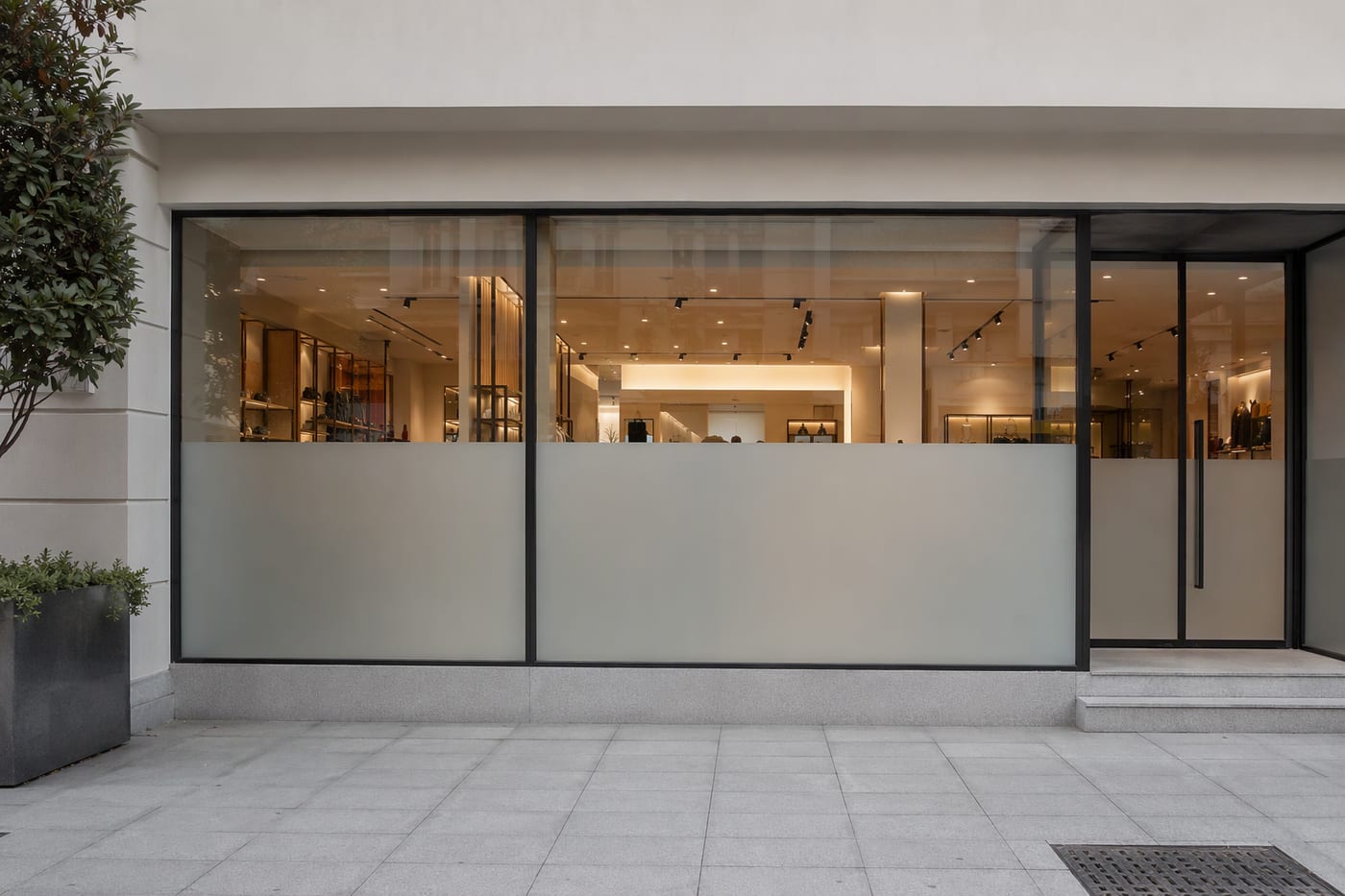
Solar control + frost band
Two problems in one shopfront: stock fading in the display window, and interior staff working in a greenhouse. UV-blocking solar film fixes the fade; a frost band at the right height fixes the privacy problem without losing the display.
Malls often standardise one grade across all tenants, which makes the film a line item in the fit-out spec.
Residential towers
Spectrally selective, 50–70% VLT
Apartments with full-height glazing overheat on west elevations and lose privacy at night. A clear electrostatic film keeps the view and the daylight while taking the worst off the afternoon; a mirror film does more work if the client will accept the reflection.
Developers specify film at handover when the glazing schedule is already fixed.
Schools & campuses
Safety film 4 mil + solar
Two specifications in one building: anti-spall film on corridor glazing, doors and low-level panes where children run, and solar control on south-facing classrooms where whiteboards wash out.
Education work is usually tendered, so the datasheet and the installation method statement matter as much as the price.
Hospitals & clinics
Frost bands + solar control
Consulting rooms and treatment areas need privacy at seated eye level while keeping daylight above it, and waiting areas need glare control without losing the sense of an outside view.
Healthcare buyers usually require low-VOC installation and out-of-hours working; both should be quoted up front.
Banks & cash handling
4 mil safety, anchored if the frame allows
The threat model is a planned entry, not an accident. That means the heavier gauge, a perimeter anchor and a crew trained on the anchor detail — specified as an assembly, with the frame checked first.
Security integrators normally buy the film and the anchor system together and install to the manufacturer detail.
Government & public buildings
Security + blast mitigation (tested)
Where a threat assessment exists, the specification is set by it. We supply the film and the documentation, and we will not describe a construction as blast-rated unless the tested assembly report covers it.
Ask for the standard and the standoff at enquiry stage; it determines whether film alone is even the right answer.
Curtain walls & facades
Reflective or clear solar, elevation by elevation
A curtain wall is not one surface. West and south-west elevations carry the load, north glass often needs nothing. Specifying per elevation cuts material cost and avoids over-darkening the floor plate.
Sealed units need an absorptance check before any film goes on — this is where most façade retrofits fail.
Industrial & warehouse
Heat rejection, high-level glazing
Rooflights and high-level ribbon glazing drive heat into packing halls and mezzanines. Film is often the only intervention that does not involve scaffolding the roof or replacing the sheeting.
Access equipment usually dominates the installed cost, so film is quoted per elevation including access.
Hotels & hospitality
Solar control + privacy
Guest rooms overheat and guests close the curtains, which defeats the point of the view they paid for. A high-VLT grade keeps the view usable, and a mirrored grade can be used where the room faces another building.
Refurbishment cycles are the usual buying moment; film goes in with the soft furnishings.
Specification logic
What actually decides the grade
The building type tells you which question to ask. It does not tell you which film to buy — four facts about the glass and the room do that.
1. The glass build-up
Single float, tinted, laminated, or a sealed unit with a coating inside the cavity. This decides whether an interior film is routine, marginal, or the wrong intervention. A laminated or low-E unit changes the answer more than the building type does.
2. The orientation
West and south-west elevations carry the afternoon load; north glass often needs nothing but glare control. Specifying per elevation is what separates a costed facade package from a building-wide over-specification.
3. The room behind it
Desks facing a screen, patients seated at eye level, stock on display, guests who close the curtains. The room sets the visible light target, and that target decides whether the film is a mirror, a neutral tint or a frost band.
4. The frame and fixing
On anything above fragment retention, the frame decides what the film can actually deliver. A dry-glazed pane with a soft gasket can be peeled out whatever thickness is on the glass.
Requirement first, product second
Requirement
What decides the answer
Common mistake
Glare on screens
Room depth and screen position
Buying the darkest film instead of the right VLT
Cooling load
SHGC of the existing glass
Assuming IR rejection predicts the load
Stock fading
Visible light, not only UV
Selling UV rejection as fade protection
Fragment injury
Glass type and frame
Treating film as a certified safety glass
Forced entry
Frame, fixing and glass together
Buying mil thickness without an anchor
Privacy
Interior lighting schedule
Specifying one-way film for a room lit at night
Limits
Where film is the wrong intervention
These five cases come up often enough that they are worth stating on a specification page rather than in a disclaimer.
Listed and heritage glazing. The film itself may be reversible, but the change in appearance is usually a consent matter. On a protected facade, the conversation belongs with the conservation officer before it belongs with us.
Glazing that is already failing. A sealed unit with a hazy edge or internal condensation is at the end of its life. Film does not repair it and will be blamed for it. Replace first, film afterwards.
Plant that cannot cope regardless. If the cooling system is undersized, film reduces the load but does not deliver the temperature the tenant expects. Say so, or the film becomes the explanation for a plant problem.
Small panes at height with no access. Sometimes the cost is entirely in reaching the glass — rope access, scaffolds, or a platform that can only be booked months ahead. Price that before the film, not after.
Frameless butt-jointed glass with a structural silicone joint. There is nowhere for an edge seal to key and no frame to anchor to. Fragment retention can still work; anything above it usually cannot.
Questions
Before you specify a building
The four questions that come up on every project enquiry.
Do different floors of the same building need different film?
Often, yes. The orientation changes the solar load, and a low floor facing a street has a privacy problem that a high floor does not. Specifying one grade across the whole tower is simpler to buy and usually over-films the north side.
Can film go on the glazing of an occupied building?
Yes, and that is the normal case. Interior work is quiet and localised, and it is phased by floor or by elevation so the building stays open. Exterior work needs access equipment and weather, but it avoids entering the space at all.
What about a building with mixed glazing — some units, some single panes?
That is where a single specification usually fails. Sealed units carry a thermal stress question that single glazing does not, so the survey has to list the glazing by type and the specification follows it.
Which building types need an anchored security system?
Banks, cash handling areas, ground-floor retail and any site where the requirement is written against forced entry. Schools and hospitals normally need fragment retention, which does not require anchoring.
Specification help
Send the building, not just the order
Most specification errors happen before the film is chosen: the glass build-up is wrong, the elevation is over-filmed, or the frame cannot take an anchor.
Send us the four lines — glass type, orientation, application and destination — and we will confirm the compatible grade before you commit to a container.